
Mapúa University, through its Campus Development, Maintenance, and Operations (CDMO) and the Institute for Global Sustainability (IGS), has partnered with The Soilmate Collective, Inc., an organization founded by Ms. Catherina Papio and known for its “Bokashi Soilmates” advocacy. The group champions zero-waste practices by promoting the Bokashi Compost Mix, a food waste fermenting agent made from rice bran, sawdust, coconut husks, molasses, and water.
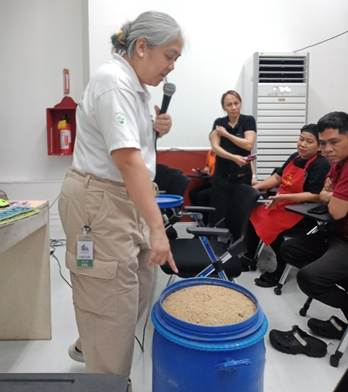
Ms. Rina Papio demonstrates the appropriate
measurement levels of Bokashi Compost mix
In June 2025, Ms. Rina Papio conducted an orientation for the university’s canteen concessionaires, introducing them to the benefits of the Bokashi Compost Mix. This session, organized by CDMO and IGS, laid the groundwork for hands-on application. In August 2025, a training session was held to demonstrate the correct ratio of Bokashi Mix to food waste, with active participation of canteen administrators and sustainability specialists.
The partnership was formally solidified in late July 2025, when Mapúa University and The Soilmate Collective signed on to work together officially. This agreement designated The Soilmate Collective as the university’s Bokashi supplier, with implementation rolling out at the start of the academic year.
Through these steps, the university not only strengthened its commitment to sustainability but also empowered its canteen partners to play an active role in reducing food waste, turning everyday practices into meaningful contributions toward a zero-waste campus.