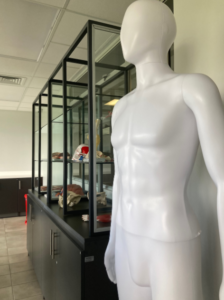
Last April, 2023, we joined a team from the Mapúa University School of Health Sciences for a visit to the Universidad Latina (ULatina) de Costa Rica, a prestigious Latin American institution offering a variety of undergraduate and graduate health science programs. We toured their facilities and engaged with faculty, students, and staff, for a firsthand glimpse of their unique and novel approach to health science education. Highlights of the visit included the following:
Active, immersive learning: ULatina takes a practical and hands-on approach to learning through hi-fidelity simulations, clinical rotations, and practice-based training. This gives students opportunities to apply their knowledge to real-world situations and contributes to the development of essential skills for future careers in healthcare.
One house, one health: At ULatina, students learn from, with, and about one another in multifunctional laboratories and interdisciplinary learning spaces. This learning model recognizes the importance of taking an integrated approach to promoting human health, animal health, and planetary health. It also allows students to practice collaboration across different healthcare fields and helps build the foundation for interprofessional team-based healthcare delivery.
Community service: Service lies at the center of healthcare, and ULatina’s outreach initiatives demonstrate a clear commitment to improving community health and well-being. The different community programs provide students with a venue to better understand the social determinants of health and gain practical experience in different settings, while making a positive impact on society.
Visiting ULatina was a wonderful chance to bridge countries and cultures, an opportunity to benchmark and share local and global best practices from two continents on opposite sides of the globe. We bring home valuable insights to help us design our very own unique and immersive learning spaces with the goal of producing practice-ready health professionals armed with digital mastery, global readiness, and a sincere desire for service and compassionate care.
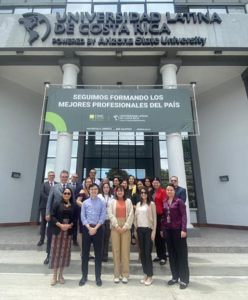
Sharing experiences with health sciences educators teaching medicine, nursing, dentistry, physical therapy, medical technology, and psychology
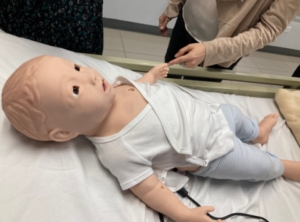
Demonstrating the functions of a high-fidelity pediatric mannequin that moves and cries, and realistically simulates health conditions such as difficulty of breathing and seizures